"Price reduction to inventory" haunts! Most PCB manufacturers’ H1 performance declines, and the industry recovery is slow. There are still opportunities in the second half of the year | Industry trend
Cailian News Agency, September 3rd (Reporter Lu Tingting)The prosperity of PCB industry is not good, and product price reduction and destocking have become the main theme of the market in the first half of the year. According to the "interim report cards" handed over by listed companies in the industrial chain, most companies’ profit margins have been squeezed, and they have fallen into a situation of "increasing income without increasing profits" or double decline in revenue, especially PCB manufacturers whose main customers are consumer electronics. Enterprises whose products are mainly distributed in downstream application markets such as automotive electronics and new energy have benefited significantly. The net profit of Shiyun Circuit (603920.SH) and Xiehe Electronics (605258.SH) both increased by over 40% year-on-year.
Many industry respondents believe that the current PCB industry recovery is slow. However, under the influence of many factors, some PCB enterprises are still facing unsaturated orders and pressure on product prices. Opportunities also exist, and the vigorous development of new energy vehicles, cloud computing and other industries will drive the continuous growth of PCB demand. At the same time, the release and stocking of new electronic products in the third quarter will also boost the supply chain demand.
Shengyi Technology (600183.SH) said that the company is currently producing at full capacity; Pengding Holdings (002938.SZ), a PCB company of Fruit Chain, said, "In the second half of the year, the company’s operation is expected to warm up and the peak season is expected to be extended to the end of the year." Under this circumstance, can the performance of PCB-related enterprises regain their upward trend?
Most companies’ performance is "eclipsed"
In the first half of this year, the recovery of the industry did not come as scheduled. On the contrary, under the continuous shadow of the market, most PCB companies’ H1 net profit was reduced or lost to varying degrees, and only a few companies made profits. Prismark predicts that the global PCB output value will fall by 4.13% year-on-year to 78.367 billion US dollars in 2023.
The upstream of PCB industrial chain is the production link of copper foil, glass fiber, epoxy resin and other raw materials and copper clad laminate; The middle reaches are PCB manufacturing; Downstream is the production of various electronic products, covering consumer electronics, automotive electronics, medical equipment, aerospace, communications, industrial control, national defense and other fields.
In the first half of the year, the upstream and downstream of PCB industry chain were under pressure. According to the incomplete statistics of Cailian reporters, among the 20 PCB-related manufacturers, 13 saw a decline in net profit in the first half of the year, ranging from 2.18% to 94.98%. There are also three net profit losses; Only four companies achieved positive growth in net profit. Except Concord Electronics, the net profit of Shiyun Circuit, Sihui Fushi (300852.SZ) and Dongshan Precision (002384.SZ)H1 increased by 46.85%, 2.24% and 3.54% respectively (compared with 70.57%, 16.42% and 31.70% in the same period of last year).
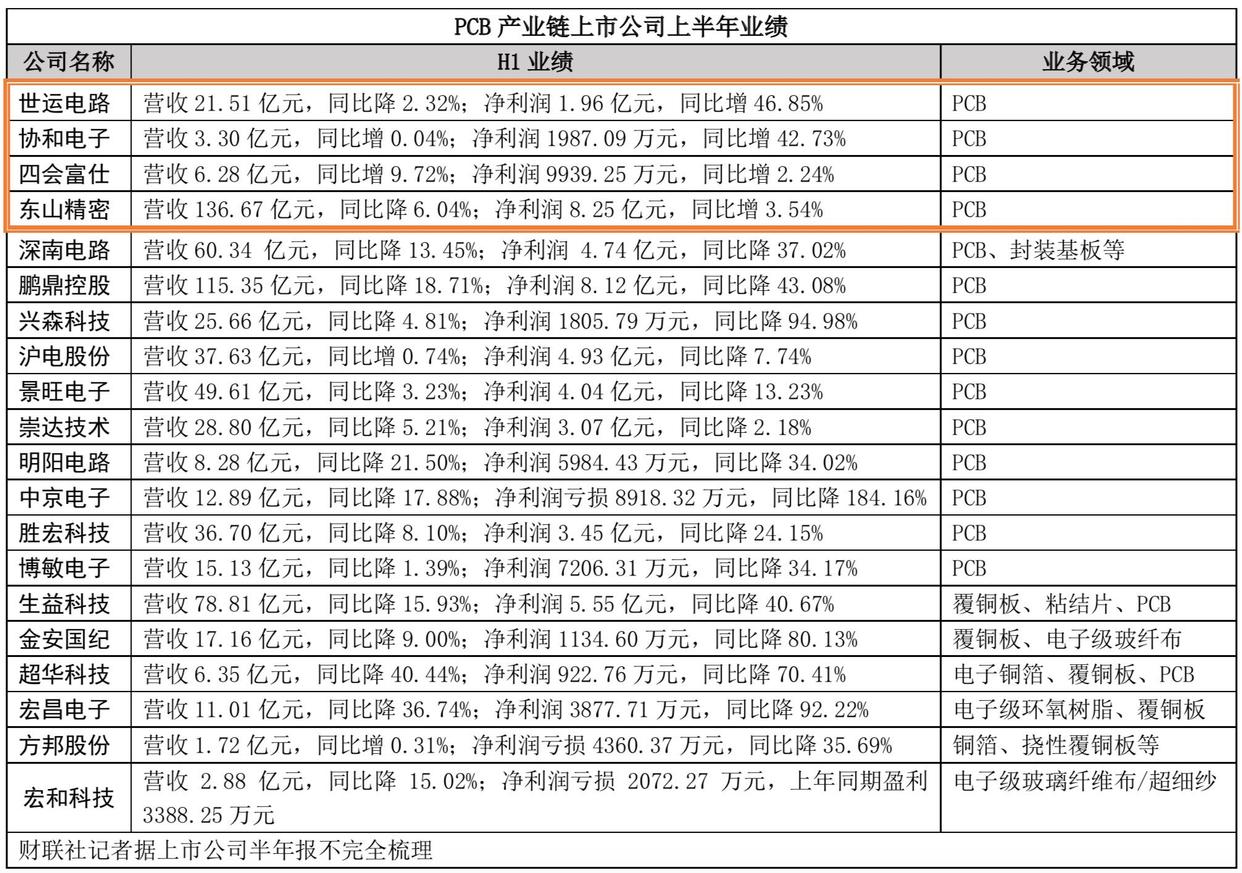
Looking through various financial reports, the reporter found that due to the destocking of end customers, the downturn in the electronic consumer market, the sharp drop in product unit price, and the less-than-expected demand in the industrial chain have become the main reasons for many PCB companies to explain the performance changes.
Li Shu, an analyst at Toubao Research Institute, said in an interview with Cailian that in the first half of 2023, due to multiple factors such as epidemic situation, chip shortage and price increase of raw materials, the market demand was unstable, and the capacity utilization rate of most PCB manufacturers declined, and the profit rate was compressed. Among them, PCB manufacturers with mobile phones and consumer electronics as their main customers have been hit hard; PCB manufacturers, whose main customers are automotive electronics, industrial control and medical devices, perform well.
The data proves that Pengding Holdings’ revenue decreased by 18% year-on-year due to the downturn of downstream communication and consumer electronics market. Shenghong Technology (300476.SZ)H1′ s net profit decreased by 24% year-on-year. The company mentioned in the semi-annual report that during the reporting period, the overall demand of the consumer electronics industry, represented by mobile phones and PCs, was weak, the industry competition intensified, and the product prices decreased compared with the same period of last year.
A small number of enterprises with net profit growth are related to "automotive electronics" and other businesses. Sihui Fushi said frankly that the main growth momentum of performance in the first half of the year came from the rapid rise of automotive electronics, and the number of customers and orders all performed well; Shiyun Circuit benefited from the relatively high share of downstream automotive electronics, and the net profit growth rate in the first half of the year was bright; One of the core application fields of Concord electronic products is automotive electronics; Dongshan Precision promoted the construction of production bases at home and abroad in the new energy automobile business. In the first half of the year, the sales revenue of new energy business was about 2.946 billion yuan, up by about 220.21% year-on-year.
In recent years, the demand for automotive PCB market has increased rapidly, which not only attracted the above-mentioned enterprises, but also attracted the layout of "Nuggets" from manufacturers including Hudian (002463.SZ) and Jingwang Electronics (603228.SH). Shennan Circuit (002916.SZ) continued to increase the development of the automotive electronics market in the first half of the year, grasping the growth opportunities brought by new energy and ADAS, and related orders increased by nearly 40% year-on-year.
The poor performance of H1 manufacturers such as upstream copper clad laminate is related to the sharp price reduction of core products. Competition in the industry has intensified. In order to maintain market share and productivity, manufacturers have no choice but to make profits at a discount. Shengyi Technology, Chaohua Technology (002288.SZ) and Jin ‘an Guoji (002636.SZ) all revealed that the price of products dropped significantly in the first half of the year. Shengyi Technology recently told Cailian reporter that "at present, the company’s copper clad laminate price is still under pressure."
The opportunity of "pulling goods" may appear
Previously, many people in the industry believed that the demand for PCB would return to the inflection point or be digested by inventory. Since the beginning of this year, the PCB industry has experienced inventory disturbances, sluggish demand, and price cuts to attract orders.
"After the adjustment in the first half of the year, the inventory has returned to a healthier level, and the second half of the year seems to be a moderate recovery." Zhou Di, an expert from the National Science and Technology Expert Database of the Ministry of Science and Technology, told the Cailian reporter.
Li Shu also holds a similar view, saying that "the current PCB industry recovery pace is relatively slow." Some executives of listed companies in the industry admitted to the reporter that "the prosperity of the traditional PCB industry has not rebounded in the third quarter, and the current prosperity is relatively average."
The overall market situation is not good, but there are also many opportunities. Li Shu mentioned, "The third quarter is the traditional peak season. With the release of new products of various electronic products and the increasing demand for stocking, the demand for PCB will also increase. With the strong support of the country, high-end PCB products will further penetrate in emerging fields such as 5G, new energy vehicles and the Internet of Things. The continuous growth of demand for high-end PCB products will drive the structural upgrading and value enhancement of the PCB industry. "
Pengding Holdings recently said, "The second half of the year is the peak season of the company’s production, and the company’s current production line is in a full state. With the launch of new products by customers, it is expected that the company’s operations will be better restored in the second half of the year."
Despite the traditional consumption peak season expectation of "Golden September and Silver 10", it is not too optimistic. Some market analysts believe that after the release of Apple’s new machine, it is expected to bring peak season effect, but the intensity of peak season remains to be seen. Zhou Di said that from the perspective of the whole year, the consumer electronics industry is still in the stage of adjustment. After the trough in the first half of the year, the second half of the year will finally usher in the traditional period of pulling goods, but at present, confidence in consumption power is still insufficient.
The more certain growth point of PCB downstream market comes from automotive PCB and AI server. Liu Shufeng, chairman of Shengyi Technology, recently told the Cailian reporter that the company is currently producing at full capacity and performing relatively well in the markets of new energy vehicles, conventional servers and AI servers, and some high-end consumer products.
Looking forward to the PCB industry in the second half of the year, Li Shu said, "It is expected that the performance of high-end PCB fields such as HDI, FPC and IC carrier board will be relatively stiff, because they are closely related to emerging fields such as 5G, new energy vehicles and Internet of Things."
2024 or an industry recovery node worthy of expectation. According to Prismark’s forecast, the whole PCB line will resume positive growth from 2024. From 2022 to 2027, the compound annual growth rate of four product lines, namely RPCB multilayer board, flexible board+module, HDI and IC carrier board, will be 3.1%, 3.5%, 4.4% and 5.1% respectively.
(Editor Cao Yuchen)