"Trade-in" ignites smart phones for new trends, and the number of stores in Guangzhou doubles.
Text/Figure Yangcheng Evening News All-Media Reporter Pan Liang
Recently, Guangdong issued the "Implementation Plan on Making Good Use of Extra-long-term Special Treasury Bonds to Support Trade-in of Consumer Goods" (hereinafter referred to as the "Implementation Plan"), and also added three types of products such as mobile phones, tablets and smart wearable devices in combination with the actual situation in Guangdong. At the same time, various cities combined with other N types of products that were actually included in the scope of subsidies to form the "8+3+N" product category. This also helps smartphone sales usher in a new round of trade-in boom.
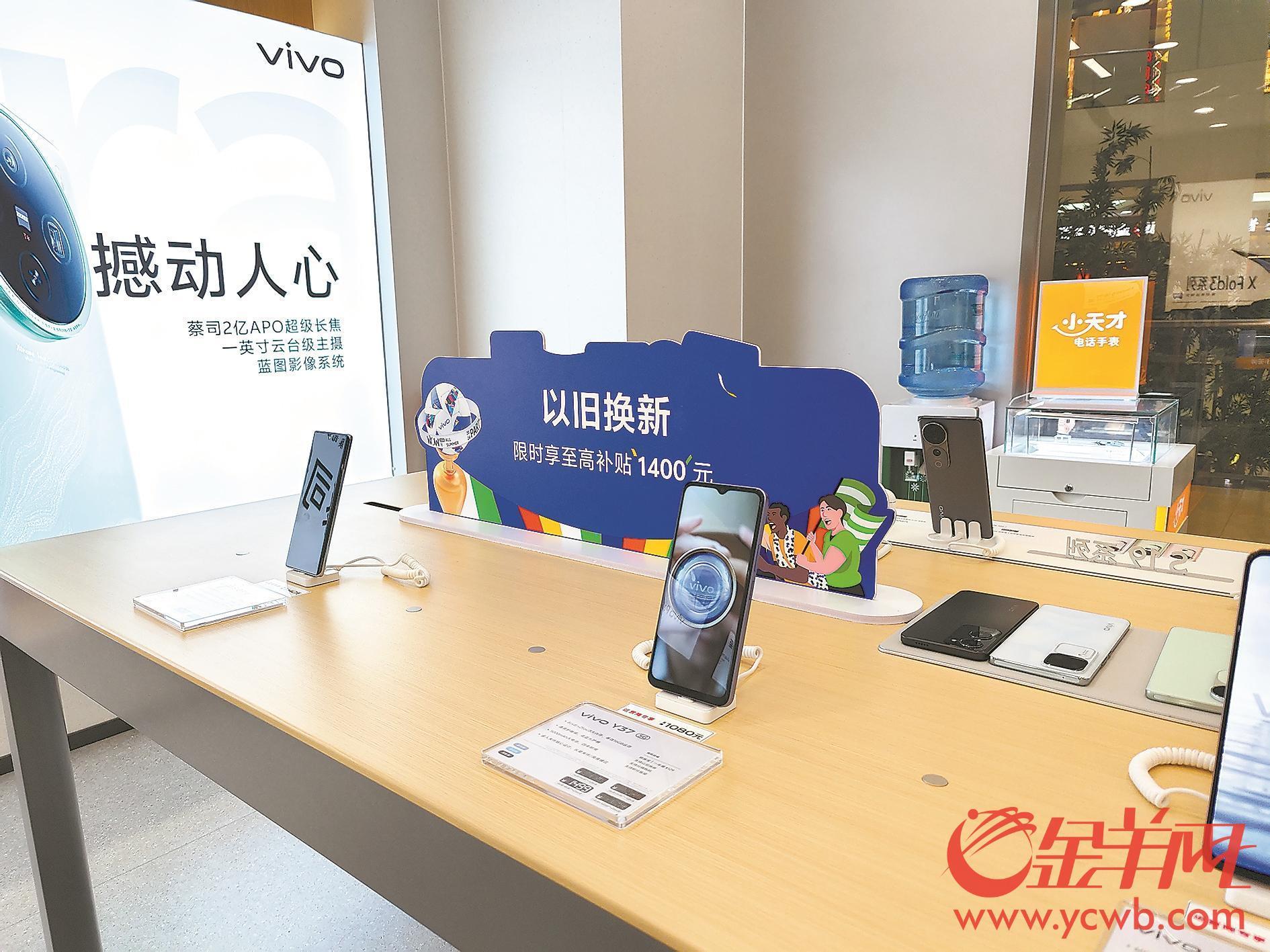
On September 2nd, the all-media reporter of Yangcheng Evening News learned by visiting offline stores that the introduction of the trade-in policy has reduced the purchase cost of consumers, stimulated the enthusiasm of consumers for trade-in and injected vitality into the smart phone market.
Smartphone market ushered in a boom.
At present, as an important position in the production and sales of smart phones, Guangdong is actively implementing the trade-in policy. This innovative sales strategy has become an important means for major mobile phone brands to attract customers and promote consumption upgrading, effectively stimulating the consumption vitality and potential of the mobile phone market.
In particular, the "Implementation Plan" mentioned that 20 measures were launched from four aspects: supporting trade-in, organization, fund management and policy publicity, vigorously promoting the trade-in of consumer goods such as automobiles, electric bicycles and household appliances, effectively releasing consumption potential, and the smart phone market was particularly boosted.
The sales manager of an Apple flagship store in Tianhe District, Guangzhou, said: "In the last two to three weeks, the proportion of customers exchanging old products for new ones has accounted for 20%-30%. With the arrival of the school season, the number of customers exchanging old products for new ones has doubled. At the same time, with the release of new models in September, it is expected that there will be better recycling. " The reporter also observed at the scene that some stores such as Huawei, Glory, OPPO and vivo have set up trade-in services to attract consumers to buy.
"The phone was a little broken before, so I want to buy a new one. Then I just learned that there is this old-for-new policy, so I used the old mobile phone for a new one. " Ms. Sun, a consumer who is buying a new mobile phone, said that "trade-in" is more cost-effective for consumers.
It is worth noting that when subsidizing individual consumers to buy three types of products, namely mobile phones, tablets and smart wearable devices, the mobile phone subsidy standard is 10% of the product sales price, and each subsidy does not exceed that of 1000 yuan. Guangzhou has accelerated the formation of a joint force of trade-in policy for consumer goods through "financial supplement, financial promotion, platform development and enterprise concession".
Domestic manufacturers take the top five sales.
At present, the domestic mobile phone market is undergoing significant changes. According to IDC’s latest report, in the second quarter of this year, the top five mobile phone shipments in China were all occupied by local manufacturers for the first time, and the traditional "leader" Apple fell out of the top five for the first time. This change reflects the trend of consumers’ shopping leaning towards domestic mobile phones, showing that China brands have made remarkable progress in technological innovation, market response and user experience, and further consolidated their domestic market share.
Relevant data show that in the second quarter of this year, China’s smartphone market shipped 71.58 million units, up 8.90% year-on-year, which continued to show growth vitality. Driven by brands such as vivo, Huawei and Xiaomi, the Android camp grew by 11.10% year-on-year. Although Apple effectively boosted the market demand through the price reduction strategy, its shipments still failed to reverse the trend, down 3.10% year-on-year. Domestic mobile phone brands have strong competitiveness and growth potential in the domestic market.
According to relevant personages in the industry, the excellent performance of domestic mobile phones is closely related to the performance breakthrough of mobile phone manufacturers. In terms of image capability, domestic mobile phones actively cooperate with imaging and optical giants such as Leica, Hasselblad and Zeiss to apply innovative color processing technology and image modules to mobile phones. In terms of call signal, charging speed, battery life and even product materials, the product advantages of "Huarong Mi OV" are also increasing.
The industry believes that mobile phone enterprises in China are actively strengthening the construction of artificial intelligence infrastructure, developing models and creating artificial intelligence applications, which will become a key competitive advantage. In the future, China smart phone brands are expected to further expand the international market.