He criticized "seeking great success and quick success". Why did Mao Zedong say that he was not a rightist but a friend?
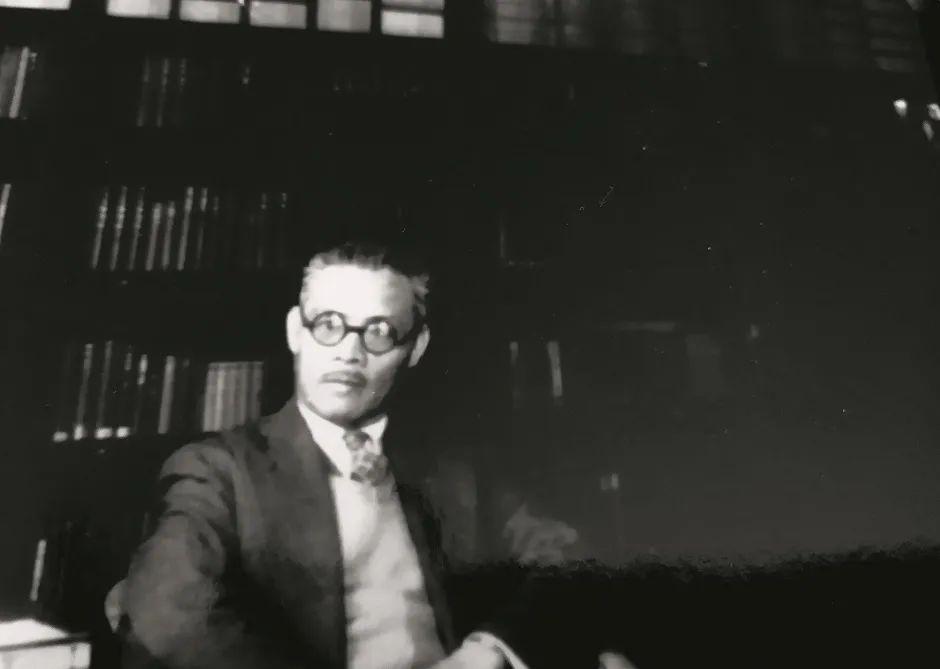
In the late 1940s, Zhang Xiruo was in tsinghua campus’s study. Figure/provided by respondents
Zhang Xiruo in his later years
Our reporter/Song Chundan
In June, 2001, Zhu Rongji, then Prime Minister of the State Council, recalled the situation when he was studying in Tsinghua in 1947 at the farewell party when he resigned as Dean of Tsinghua University Institute of Economics and Management. He said that he enjoyed listening to Mr. Zhu Ziqing’s speech, and he also enjoyed going to Mr. Zhang Xiruo’s house and sitting on the ground, listening to Mr. Zhang talk about the world and cursing the Kuomintang, and his belief was established at that time.
Zhang Wenpu, the son of Zhang Xiruo and later China’s ambassador to Canada, also studied in Tsinghua University at the same time, but he studied history and didn’t know Zhu Rongji from the Department of Electrical Engineering. In the 1980s and 1990s, Zhang Wenpu worked in the Department of American Studies of the Ministry of Foreign Affairs and the Chinese People’s Institute of Foreign Affairs successively. On several occasions, he accompanied Zhu Rongji to meet foreign guests and reported in advance. As a rule, he had to declare his name and department first. Zhu Rongji said, of course, he knew who you were, Zhang Wenpu.
Zhang Wenpu told China Newsweek that he always felt that there was plenty of time, and he could hear his father’s remarks at home every day. As a result, he didn’t listen to his father’s class and speech, which became his irreparable regret.
In the early 1960s, many of Zhang Xiruo’s close friends joined the Party, and his family also advised him to consider joining the Party, which he declined on the grounds that it was "difficult to meet the standards". Zhang Wenpu felt that it might be more in line with his father’s character to end his life as an independent.
"Democrats without party affiliation" who are active in politics.
In the early days of New China, Zhang Xiruo was active in politics.
As is widely known, at his suggestion, the name of the new China was "People’s Republic of China (PRC)", and the words "democracy" or "democracy" originally proposed were removed. When discussing March of the Volunteers as the national anthem, some people think that times have changed, at least the lyrics should be changed. Taking the French Marseillaise as an example, he emphasized that retaining the lyrics during the revolutionary war would help inspire future generations.
He Bingdi, a great national historian, said in Sixty Years of Reading History that Zhang Xiruo had a long talk with Mao Zedong and urged him not to send troops to North Korea. But Zhang Wenpu thought it was impossible. The relationship between Zhang Xiruo and Mao Zedong was not deep enough to talk all night, and he could not just enter Zhongnanhai. However, when he came back from a meeting in the city, he was really worried. He said to Zhang Wenpu, That’s someone else’s baby. Why should we send troops?
When the departments were adjusted in 1952, the arts and sciences in Tsinghua were transferred out. A group of professors thought that Tsinghua would be "dismembered" in this way, and they were very worried and dissatisfied. Zhang Xiruo was a member of the Central People’s Government at that time, but he was still a professor in the Political Department of Tsinghua. Qian Weichang, Qian Sanqiang, Fei Xiaotong, Tu Shoukai and others came to see him, hoping that he would make a complaint to the Central Committee. After Zhang Xiruo conveyed it, Zhou Enlai specially talked with him, explaining that the adjustment of departments and colleges was to speed up the cultivation of a large number of talents needed for industrialization, which the old system could not do. Since then, he has not insisted.
The old friends of Zhang Xiruo’s "Saturday party" have been greatly affected by the adjustment of departments.
This party was organized by Jin Yuelin at his home in Beiping North General Hutong in the 1930s. Liang Sicheng and Lin Huiyin, Zhang Xiruo, Tao Menghe, Zhou Peiyuan, Chen Daisun, Deng Yizhe, Qian Duansheng and Li Ji often attended. Most of these people are professors from Tsinghua, and almost all of them have the experience of studying in Europe and America. The party always begins with discussing the current political situation, but it is more about literature and art. Deng Yizhe, the father of Deng Jiaxian and an aesthete, is the keynote speaker on the latter topic, and sometimes he brings some calligraphy and painting for everyone to enjoy.
After the outbreak of the Anti-Japanese War, old friends moved to Kunming again.
Jin Yuelin was Zhang Xiruo’s classmate when he was studying in the Department of Political Science of Columbia University, and he was also his best friend for the longest time. In those days, Zhang Wenpu called Jin Yuelin "Golden Dad". Zhang Xiruo once recommended Zhang Wenpu to read a philosophical paper written by Jin Yuelin in English. The first sentence is: If China’s philosophy entered the WTO and western philosophy was born, then Indian philosophy is in the other world. Zhang Xiruo said that it is rare for Chinese to write in English, and it is so subtle to make sentences.
In Kunming, Zhang Xiruo was the head of the Political Department of The National SouthWest Associated University and the representative of the National Political Council. In the summer of 1940, he went to Chongqing for a meeting, and left Zhang Wenpu and his younger brother at Zhou Peiyuan’s home near Kunming Lake at the foot of Xishan Mountain. The foreign physicist who worked as Einstein’s assistant walked barefoot across the plank road every morning and carried water home with a pair of big wooden barrels, both for food and for drinking horses. At that time, he raised a Yunnan pony named "Hualong", and riding to school became a spectacle in The National SouthWest Associated University.
"Aunt Liang" Lin Huiyin always calls Zhang Wenpu’s nickname when she leaves Zhang Xiruo’s house, asking him to help put a single bed on the wall of Zhang Shun vertically, which is more aesthetic. But as soon as she left, Zhang Xiruo immediately told Zhang Wenpu to put the bed back to its original state, apparently thinking that putting it against the wall would save more space. So many times, the children can’t help laughing.
After the victory of the Anti-Japanese War, most members of the "Saturday Party" returned to tsinghua campus, and almost all of them stayed in the mainland after 1949.
After the adjustment of departments, Jin Yuelin and Deng Yizhe were transferred to Peking University with the Department of Philosophy of Tsinghua University, Zhou Peiyuan went to Peking University with the Department of Physics of Tsinghua, Chen Daisun went to the Central College of Finance and Economics with the Department of Economics of Tsinghua, and Qian Duansheng went to the newly established Beijing Institute of Political Science and Law with the School of Law of Peking University. Only Liang Sicheng and Lin Huiyin remained in Tsinghua, but the comprehensive construction department created by one hand was changed into a purely engineering department.
In November 1952, Zhang Xiruo left Tsinghua University, where he had taught for 23 years (his political department had been merged into Peking University), and was appointed Minister of Education to replace Ma Xulun. His salary was set at the third level of administration equivalent to that of Vice Premier the State Council, and his family moved into a deep courtyard in Beichang Street on the east side of Zhongnanhai. In addition to the car driver, there is also a security guard stationed in the station.
Zhang Xiruo is also the president of the Chinese People’s Institute of Foreign Affairs. He held this position from 1949 until his death in 1973.
In the early days of the founding of New China, most western countries did not establish diplomatic relations with China, and the main purpose of the establishment of the Institute of Foreign Affairs was to develop contacts with these countries in a non-governmental manner. As a non-Party person, Zhang Xiruo seldom participates in decision-making, and he doesn’t have to go to work at ordinary times. He is basically engaged in concierge work. However, he is respectful and devoted to foreign affairs. Every time he has an activity, he always listens carefully to the introduction, reads the documents and gets ready.
Jin Yongjian, who worked as an English translator at the Chinese People’s Institute of Foreign Affairs from 1954 to 1964 and later served as the UN Under-Secretary-General, told China Newsweek that at that time, every time the newspaper reported the dignitaries attending major events, after the leaders of the eight democratic parties, the last one was Zhang Xiruo, a "Democrat without party affiliation".
"the famous gunner"
In the spring of 1957, the Central Committee of the Communist Party of China decided to carry out the rectification movement throughout the Party, and invited people outside the Party to help the rectification movement. In May, the United Front Work Department of the CPC Central Committee invited democratic parties and Democrats without party affiliation to hold a forum.
On May 13th, Zhang Xiruo analyzed the roots of bureaucracy, sectarianism and subjectivism. When he analyzed sectarianism, he said, at the beginning of liberation, some party member thought that the world was laid by themselves, and it was good for non-party people to enjoy a bowl of rice and give you an official job. What about you? To be clear, it’s just for unity, not what skills you have, besides, you are not clever. For the masses, sometimes the people are long and the people are short, but it is just a mantra.
His criticism of the "Three Principles" resonated with many people. On May 15th, he spoke again, focusing on the deviations existing in the work of the Party and the government, and summarized them into 16 words: be fond of great success, be eager for quick success, despise the past, and be superstitious about the future.
Zhang Xiruo was once called "a famous gunner" by his friend Xu Zhimo because of his honest and frank personality and his frequent voice on social issues.
At a meeting of the National People’s Political Consultative Conference in March 1941, the "Ministry of Finance" reported that China had no inflation account and its economy was in good condition. Zhang Xiruo sarcastically said: That depends on what standard to measure. If you can find money in the sewer to be considered inflation, it is not. Then, I asked the report one by one. Chiang Kai-shek, who presided over the meeting, rang the bell for a long time to stop him from continuing to speak. He insisted on finishing his speech and refused to go to the meeting again, and called back: there was no politics to discuss, and the fare was refunded.
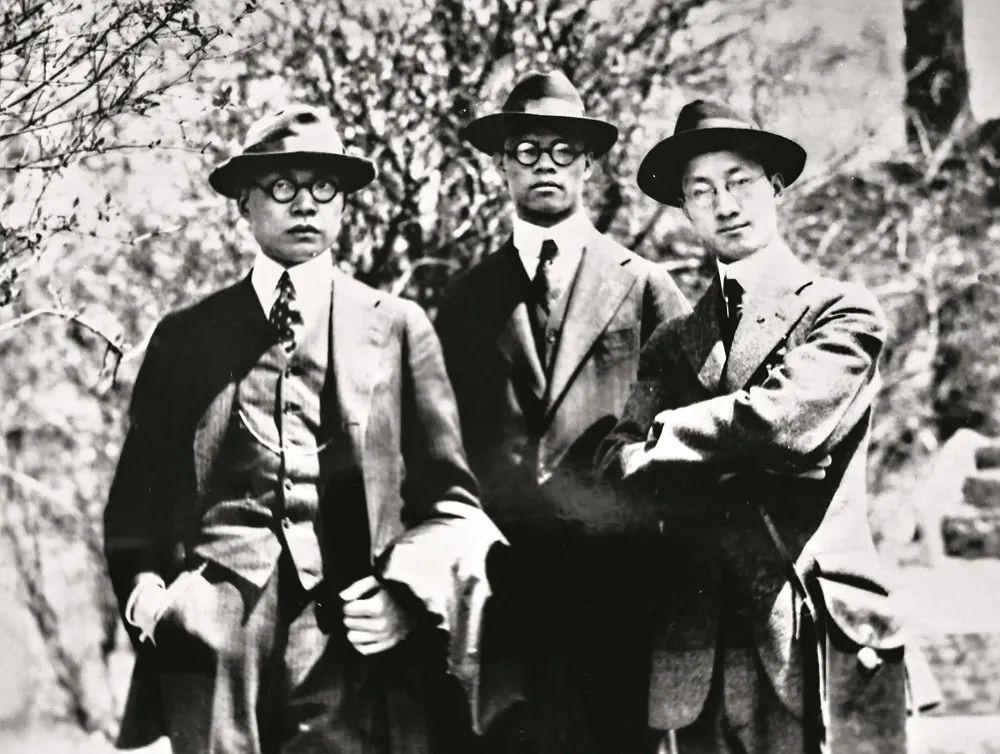
Zhang Xiruo (middle) poses with Jin Yuelin (left) and Xu Zhimo at Columbia University. Figure/provided by respondents
In the winter of 1943, he delivered a speech on "Constitutional Issues in China" and publicly attacked the Kuomintang government. He said that the purpose of constitutionalism is the rule of law and the rule of the people, especially the rule of the people. A constitution does not necessarily mean a constitutional government. The Kuomintang treated the people as a bucket and practiced "political training" for many years. "If we really want to implement constitutionalism in good faith, we must first end the’ political discipline’, that is, end the one-party dictatorship of the Kuomintang."
In 1947, he published "Talking about the Current Situation" in newspapers and magazines, and wrote: Although it is not easy to say whether politics is on the right track after the collapse of this government, it is an inevitable conclusion that politics will never improve before the collapse of this government.
On November 25th, 1947, the Political Department of Tsinghua held a symposium on "China’s Political Future". Zhang Xiruo predicted at the symposium that after the victory of the revolution led by communist party, the socialist system would be implemented in China. In the face of the audience’s questions, he said, there is nothing absolutely perfect between heaven and earth. At each historical stage, we can only fulfill our historical tasks. If there are problems in the future, there will naturally be ways to solve them.
Zhang Wenpu believes that Zhang Xiruo’s 16-character criticism in 1957 was mainly caused by the construction of Beijing.
Like Liang Sicheng and Lin Huiyin, Zhang Xiruo has a stubborn attachment to the ancient capital of Beijing. He once compared Beijing with Paris, and thought that they were lovely and pleasant because they both had two elements: medieval and modern. He believes that the Forbidden City is an ideal combination of solemnity and beauty, which is rare in the world. He opposed the demolition of city walls and archways, especially the demolition of the "three doors" on the east and west sides of Tiananmen Square. Some people say that the "Three Doors" have caused traffic accidents, causing death and injury. There is public anger and they must be demolished. Zhang Xiruo retorted in front of Zhou Enlai: "Are all the traffic accidents in Beijing in places with archways? If there is a car accident, should the dead archway be responsible or should the living person be responsible? " At a meeting, Peng Zhen criticized him for "being infatuated with the past and not learning from the past". Zhang Wenpu believes that it is precisely because of this sharp argument that Zhang Xiruo breathed a sigh of relief, and the last two sentences can also be said to be a reply to Peng Zhen’s remarks.
Unexpectedly, in the subsequent "anti-Rightist" movement, quite a few Democrats were classified as Rightists, but Zhang Xiruo was safe.
At a Supreme State Conference in early 1958, Mao Zedong severely criticized Zhang Xiruo who was present, but stated: "It was a friend who said these words, not the Rightists." At this meeting, Zhang Xiruo made a reflective speech, explaining why he was in conflict with the policy, which was recognized to some extent. Mao Zedong said that not all the old things are good, but all the new things are bad, and Qingdao is better than Kaifeng and Luoyang. In this regard, Zhang Xiruo was not completely convinced. He said to Zhang Wenpu: "When it comes to this, do I see more, or does he see more?"
Chen Mingshu of the Central Committee of the Revolutionary Committee of the Chinese People’s Republic of China also put forward similar criticisms, which were classified as Rightists. Why Zhang Xiruo was not classified as a rightist has long been a mystery. Some people say that Zhou Enlai came forward to protect him, but Zhang Wenpu felt that Zhou Enlai was only recently criticized for "anti-aggressive" and his own situation was already very difficult. Can he still protect Zhang Xiruo? Later, an old-timer who read a lot of materials told him that Deng Xiaoping played a protective role, and he could not judge. He feels that at least one thing is certain, that is, his father’s style of never forming cliques has helped him. Among the well-known democrats, Zhang Xiruo only had more contacts with Chen Shutong at that time, and he never joined any tangible group, so he was a "one-man household".
After being criticized, Zhang Xiruo lived in seclusion, closed the door, and once wanted to resign. Zhou Enlai visited him at home. In February 1958, Zhang Xiruo was removed from the post of Minister of Education, but was appointed as the director of the Foreign Cultural Liaison Committee until the institution was abolished during the Cultural Revolution.
"Xi Lao"
In October 1959, Tang Mingxin, a Spanish major at the Foreign Affairs University, was seconded by the Institute of Foreign Affairs to receive a visiting Uruguayan parliamentary delegation and met Zhang Xiruo for the first time. In April 1960, he was seconded to receive a delegation of Latin American friendly people. Zhang Xiruo was satisfied with his two translations. Due to the shortage of Spanish translations, he left him at the Institute of Foreign Affairs before he graduated.
Tang Mingxin recalled to China Newsweek that Zhang Xiruo had a talk with him in his office. Zhang Xiruo said that the Institute of Foreign Affairs was initiated by Premier Zhou Enlai and was the first institution in New China to engage in people’s diplomacy. At present, due to the obstruction and destruction of the United States and other western countries, China’s relations with Latin American countries and Spanish-speaking countries are full of difficulties.
Therefore, we should vigorously carry out non-governmental diplomacy and promote the development of state relations. This is also the work that Tang Mingxin should devote to in the future.
Tang Mingxin respectfully said that he has deep respect for President Zhang, because as early as watching founding ceremony’s documentary, he saw him standing in the lofty position behind Chairman Mao, and he also knew that he was the initiator of the country name. It was his blessing to work under his leadership, so he must work hard. Zhang Xiruo smiled and said, yes, it was a period of history when he took part in the revolution, but the revolution is endless, and he will try to move forward in the future to catch up with the times.
On the morning of November 5, 1960, Zhou Enlai met with the non-party ministers and deputy ministers of various ministries and commissions in the State Council at the Great Hall of the People. He affirmed Zhang Xiruo’s work in the Chinese People’s Institute of Foreign Affairs, saying that "the busiest person is Zhang Xilao", and he also reviewed his criticism of Zhang Xiruo for preventing the demolition of archways, saying that Zhang Xiruo could accept Mao Zedong’s criticism, which reflected ideological progress.
At the end of 1961, Sian Como, president of Zimbabwe African Union, visited China, and Zhang Xiruo and Qiao Guanhua hosted a banquet in Sichuan Hotel, with Jin Yongjian as translator. During the dinner, we talked and laughed, and the atmosphere was pleasant. Zhang Xiruo also used chopsticks to pick up food for foreign guests. Everyone respects Zhang Xiruo and calls him "Xi Lao".
In 1963, General Charles de Gaulle sent former Prime Minister Fuer as a special envoy to China. Zhang Xiruo hosted a welcoming banquet and accompanied Zhou Enlai to the meeting, but did not participate in the subsequent secret negotiations on the establishment of diplomatic relations. In his memoirs, Fuer mentioned Zhang Xiruo, thinking that he was more than just a "non-party foil".
In the 1960s, Wang Chuguang entered the general office of the Foreign Cultural Liaison Committee as a secretary. He told China Newsweek that the Foreign Affairs Commission is the real power department in charge of controlling foreign cultural work in the State Council, but Zhang Xiruo only visits the organs once a week, regardless of other matters, and the actual affairs are handled by Li Chang, deputy director and party secretary.
Every Monday morning, Zhang Xiruo’s car stopped in front of the office building, and the secretary stepped forward and opened the door. He is over 70 years old, but he is still full of energy, handsome, with a big gray back, tortoise-shell glasses, a tailored dark gray Chinese tunic suit, shoes, a civilized stick and steady steps. After entering the building, the secretary helped him take off your coat take off his hat and accompanied him into the elevator that had already been waiting there. When the elevator reached the third floor, the secretary accompanied him into the office, served tea and poured water, put the documents on the table for reading, and then quietly quit. He stayed in the office for about an hour, with no one to talk to or report to him. Every time it comes quietly, it goes away, all the year round.
One morning during the break, Wang Chu was standing in the corridor chatting with several secretaries. When he saw Zhang Xiruo coming, he immediately retreated to both sides and said loudly, "Hello, Zhang Xi!" Perhaps on a whim, Zhang Xiruo stopped to talk with them and talked about his life experience: how to leave Shaanxi and how to participate in the Revolution of 1911; How to study abroad and how to attack the corruption of the Kuomintang; How to greet the founding ceremony, how to participate in the construction of People’s Republic of China (PRC) … I talked for nearly an hour.
After seeing Zhang Xiruo leave, Wang Chuguang was crying, thinking that Mrs. Zhang Xi might be lonely. It’s really famous, and her singing is also sad.
A hard-working man
During the "Cultural Revolution", Zhang Xiruo did not suffer any impact. At the end of 1966, Zhou Enlai personally listed a "list of cadres to be protected", in which there were 13 senior Democrats, among whom Zhang Xiruo was one. Zhang Wenpu felt that his father didn’t join the Party, and if he became a leading cadre in party member, it might be hard to survive the Cultural Revolution.
At the beginning of the "Cultural Revolution", Zhang Xiruo had a strong interest and often went to the Foreign Languages Committee to read posters. However, with the development of the movement, he felt confused and determined to remain silent and stay out of it. Young people sometimes talk about "Heaven School" and "Earth School" at home, and he never gets involved. Zhang Wenpu brought home some materials for writing posters from the Ministry of Education where he worked, and Zhang Xiruo asked him to take them away as soon as he knew.
Once, Zhang Xiruo came back from an activity outside and said with a smile that he had met Chen Yi. Chen Yi said to him, "Xi Lao, we are just like you now!" " (meaning that you have the right to stand aside. ) At the end of the movement, Zhang Wenpu occasionally heard Zhang Xiruo say, "What if you flip your hand again?"
In 1969, the work of the Institute of Foreign Affairs was interrupted (resumed in 1973). Tang Mingxin was also sent to work in the May 7th Cadre School of the Ministry of Foreign Affairs in Jiangxi this year. When saying goodbye, Zhang Xiruo charged him with a heavy tone. Under the current situation, he should calmly observe political trends, neither lose his way in the rebellion that shook the earth and denied everything, nor be confused by conservative words and deeds that refused to criticize and covered up mistakes. "There is still a long way to go in the future, so be careful!" Shang Mingxin thinks that this is Zhang Xiruo’s heart-to-heart talk.
When Nixon visited China in 1972, Zhang Xiruo was among those who welcomed him. However, he suffered a heart attack, and Zhou Enlai temporarily decided that Zhou Peiyuan would be the vice president of the Institute of Foreign Affairs instead. This became a pity for Zhang Xiruo in his later years.
This year, Zhang Xiruo also met Fei Zhengqing, an old friend who was visiting China. Fei Zhengqing once described Zhang Xiruo as the most Anglo-Saxon individualist among the liberal intellectuals in Kunming, but he described this meeting as "Did Most of the Talking But Said Little" (without saying anything). Later, Zhang Wenpu, who had been engaged in diplomatic work for many years, admitted that Fei Zhengqing’s writing style was brilliant, but what could his father say? He was in charge of foreign affairs discipline.
In 1973, Zhao Yuanren visited China from the United States and met Zhang Xiruo, an old friend in hospital. Zhao Yuanren is a linguist who can speak 33 Chinese dialects. Zhang Xiruo taught him a Shaanxi ballad. Zhao Yuanren imitated Shaanxi dialect to read this ballad, which made Zhang Xiruo very happy.
On July 18th this year, 84-year-old Zhang Xiruo died. Zhou Enlai, Ye Jianying, Li Xiannian and Deng Xiaoping attended the memorial service, which was presided over by Deng Xiaoping.
In November 1989, Tsinghua University commemorated the centenary of Mr. Zhang Xiruo’s birth, and Xi Zhongxun, then vice chairman of the National People’s Congress Standing Committee (NPCSC), made an impromptu speech at the meeting. He said: "Zhang Xi and I are both from Shaanxi. When I go to him, he always wants to invite me to dinner at home. I often say to him, Xi Lao, you went abroad to study in 1913, looking for a way to save China and pursuing truth and knowledge, and I was born then. No matter what kind of experience you have, you are much more than me. "
Friends Xu Zhimo once said that Zhang Xiruo, this gentleman is a hard man, his body is hard, his character is hard, his will is hard, and his speech is hard.
Tsinghua colleagues Hsiao Kung chuan and Pu Xuefeng are critical of this "hard man". Hsiao Kung chuan once said in his memoirs that both Zhang Xiruo and Qian Duansheng later became officials in the people’s government, and both of them held the aspiration of learning to be excellent and being an official, and their daily words could not help but reveal their frustration. Therefore, in Hsiao Kung chuan’s view, they all stayed for "political desire" rather than out of faith.
Perhaps that’s why Zhou Peiyuan’s wife, Wang Di-pei, said that Zhang Xiruo was completely square, with sharp corners. Whoever was touched by sharp corners would certainly feel bad. But she added that the four sides of this square are broad and amiable. Jin Yuelin agreed with her.
When Wen Yiduo was killed, Jin Yuelin was in Chongqing. When he heard that Zhang Xiruo was also killed, he wrote a pair of elegiac couplets: This is a straight line, why bother to care about the world, treat each other with sincerity, and be more related to each other’s faults, and make love with the same flesh and blood; The argument between righteousness and benefit is not tolerated by the traitors, and the virtues are not obvious. The advice is taboo, and the right and wrong are fixed. The suspicion is all fur.
Later, I learned that Zhang Xiruo was not killed, and this pair of elegies was shelved. In 1961, Jin Yuelin sent it to Zhang Xiruo again, with a postscript: "Yellow flowers in autumn, fallen leaves in winter, and spring thunder swept away, but at that time, it seemed that there was still loyalty."
Zhang Wenpu felt that studying in America and Europe for 12 years in his early years left a deep mark on his father. His living habits, ways of thinking and ways of dealing with others are quite westernized, or modernized. However, when Zhang Wenpu’s brothers and sisters were young, Zhang Xiruo first asked them to read Tang Poetry and Song Poetry, and "Ancient prose". He did not advocate that they should get in touch with western culture and learn English too early, for fear that they would have no roots when they grew up, and it would be difficult for them to integrate into the mainstream society in China.
When he was in Kunming, Zhang Wenpu finished Grade One in a missionary middle school, and was ordered to drop out of school because he was naughty and his lessons were in a mess. The other party is also good at diplomatic rhetoric, saying that your son is too talented to teach. Zhang Xiruo was furious. After personal testing, he found that Zhang Wenpu had been in English class for a year and could not recognize all the letters. He slapped him severely and took the time to help him with his English.
Zhang Wenpu remembers that his father taught him to read Rousseau’s Theory of Social Contract. Zhang Xiruo admired Rousseau and often recited the famous sentence in the book: "Man is born free, and everywhere he is in chains." (People are born free, but they are everywhere in chains. Every time he reads this, he is always generous and sad, and his passion is hard to suppress.
Reporting/feedback